A grade is an opinion
Truer words were never spoken about the grading racket in this business. No, your vibe-coded app is not the "most accurate" grading tool either.
PSA told a court recently that a grade is "an expert opinion." The problem was never the grade. It's that no one in this industry shows their work.

What PSA Actually Built
A PSA grade is the closest thing this hobby has to currency. Its value comes from millions of people agreeing to treat it as money. Decades of volume, a population report the entire market uses for pricing, and thirty years of compounded trust. PSA earned it.
Courts should decide if a company broke the law, not whether a card is a 7 or an 8. A standard that sways because someone filed a complaint is worth less, not more. PSA is right: a grade cannot be litigated into existence, nor litigated out of one. Relitigating a single card from decades ago has nothing to do with how this market operates today.
Everyone sells accuracy. No one shows it.
The core issue in grading is that the entire industry refuses to show its work. Everyone sells "accuracy" and "expertise," yet hides the underlying data required to verify either. How often does the same card receive the exact same grade, or two independent graders agree? Neither incumbents nor startups publish these metrics, forcing collectors to trade five-figure assets on pure vibes ("trust me bro").
This opacity is even worse among the new wave of "vibe-coded" apps claiming world-class accuracy from a single phone photo. A single uncontrolled phone photo cannot reliably capture every defect needed to distinguish a 9 from a 10, especially fine scratches, gloss degradation, and angle-dependent surface damage. Anyone claiming otherwise isn't further along; they're just being less honest.
Step back, and the broader problem is stranger: nobody is checking the checkers. In markets where ratings and valuations carry financial weight, independent checks are common: registered credit-rating agencies answer to SEC oversight, and gold bars can be tested by assayers. Yet in grading, the company writes the test, takes the test, and certifies itself. No one is asking for government regulation on Pokémon cards, but if a company claims to be accurate, they should show enough work for the market to verify it. That shouldn't be controversial.
What We're Doing Instead
I run one of these companies, so hold us to the same standard. Covet grades cards, and our grade is an opinion. We will get them wrong. A newer logo doesn't make our number truer than theirs, and we won't pretend otherwise.
What we can do is refuse to hide. We break down every factor, centering, corners, edges, surface, so you see how we reached a grade, not just where it landed. When a camera angle can't support a sub-score, we mark it "not scored" rather than invent a number. And we will publish our full dataset, the cards, the scoring, the misses included, for anyone to audit or challenge.
Until that data is public, treat this as a promise, not proof. That's fair.
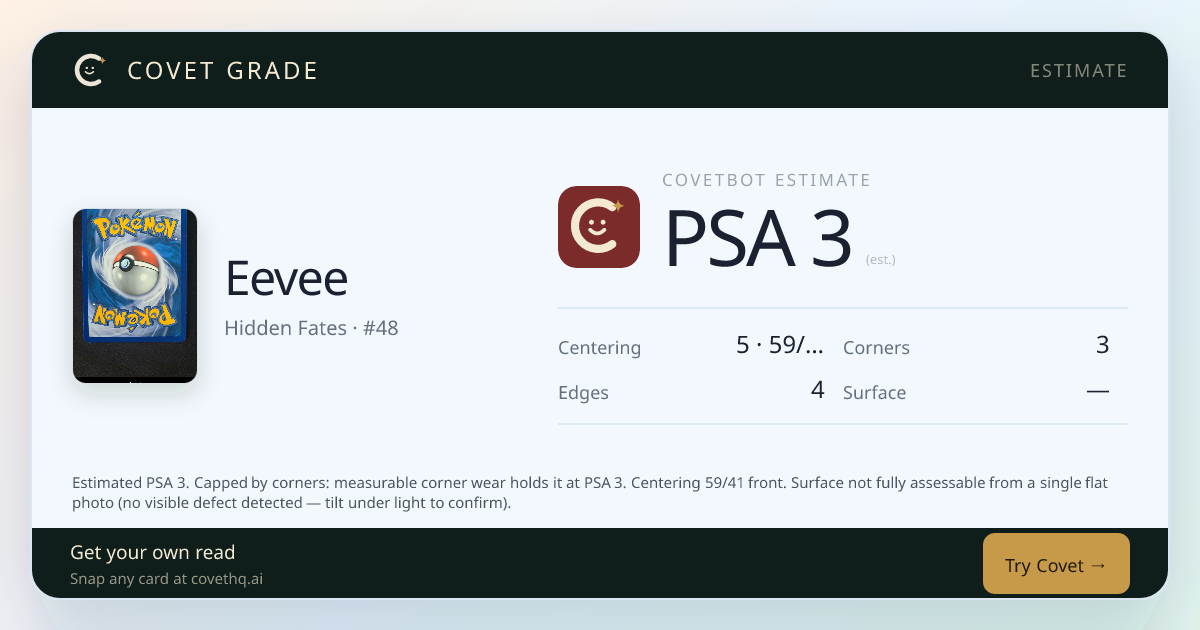
None of this needs a court, a regulator, or a lawsuit. Any of us could do it tomorrow. Almost none of us have.
This whole category runs on "trust me bro." At these stakes, that isn't good enough anymore.
Trust, but verify. Show the data.
Ask Covet about a card. You'll get the reasoning, not just a number.
Sources: PSA's public statement describes a grade as "an expert opinion" whose value "rests on the fact that specific grades cannot be bought, pressured, or litigated into existence." Registered credit-rating agencies are subject to SEC oversight. The grading suit is Funk v. Collectors Universe (PSA); the complaint was filed in federal court in Maryland in July 2026, and its status is available on the CourtListener docket. The allegations are unproven.